


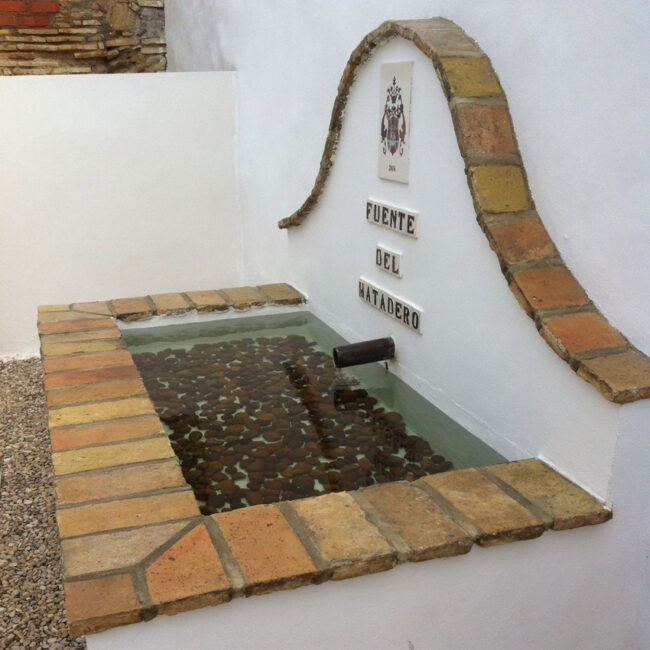
La Fontaine de l’Abattoir est située dans la partie sud d’Espejo, à côté de l’ancien abattoir municipal dont elle tire son nom. Sa structure est simple, composée d’un bec versant l’eau dans un abreuvoir rectangulaire en maçonnerie et enduit, qui servit pendant des décennies de point d’approvisionnement pour les habitants et surtout pour le bétail conduit à l’abattoir.
Avant l’arrivée de l’eau courante, cette fontaine faisait partie du réseau de ressources hydrauliques essentielles à la vie quotidienne du village. Bien qu’elle ait perdu aujourd’hui sa fonction d’origine, elle demeure un vestige significatif du patrimoine hydraulique d’Espejo et du mode de vie antérieur au XXe siècle.
The Fountain of the Slaughterhouse is located in the southern part of Espejo, next to the old municipal slaughterhouse from which it takes its name. Its structure is simple, featuring a spout that pours into a rectangular trough made of masonry and plastered, which for decades served as a water supply point for the neighborhood and, above all, for the livestock brought to the slaughterhouse.
Before the arrival of running water, this fountain was part of the network of essential hydraulic resources for the town’s daily life. Although it has lost its original function today, it remains a significant vestige of Espejo’s hydraulic heritage and of the way of life prior to the 20th century.
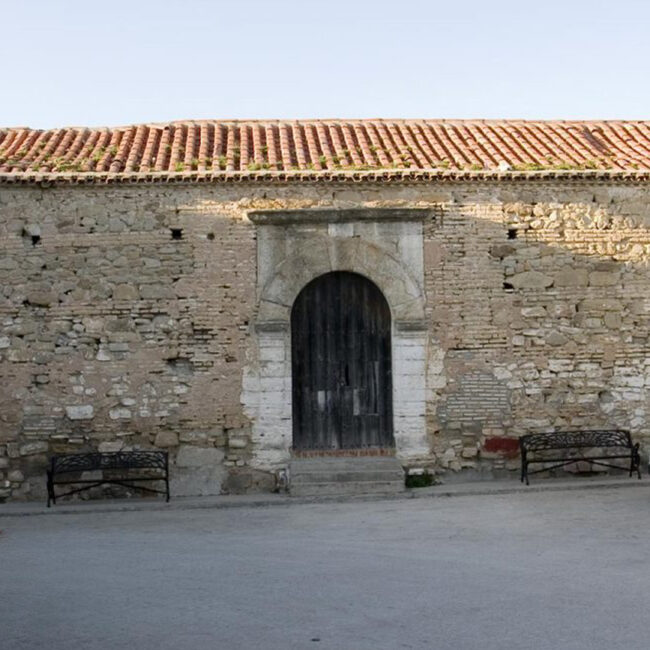
Située à l’extrémité sud-est d’Espejo, elle fut probablement fondée dans la première moitié du XVIe siècle. Dès ses origines, elle abritait une chapellenie dédiée au culte et à l’enseignement de la doctrine chrétienne, ce qui reflète son importance dans la vie religieuse locale.
Au fil du temps, outre son rôle de lieu de culte, elle servit également d’école dès le XVIIIe siècle au moins, et fut restaurée à cette fin après être tombée en ruine au XIXe siècle. Bien que sa fonction spirituelle soit aujourd’hui limitée, sa sobre façade d’origine est toujours conservée, et l’ermitage reste un symbole populaire qui donne son identité à l’un des quartiers les plus traditionnels de la commune.
Located on the southeastern edge of Espejo, it was probably founded in the first half of the 16th century. From its beginnings, it housed a chaplaincy dedicated to worship and the teaching of Christian doctrine, reflecting its importance in the town’s religious life.
Over time, in addition to being a place of worship, it also served as a school from at least the 18th century and was restored for that purpose after falling into ruin in the 19th century. Although today its spiritual function is limited, its original sober façade is still preserved, and the hermitage remains a popular symbol that gives identity to one of the town’s most traditional neighborhoods.
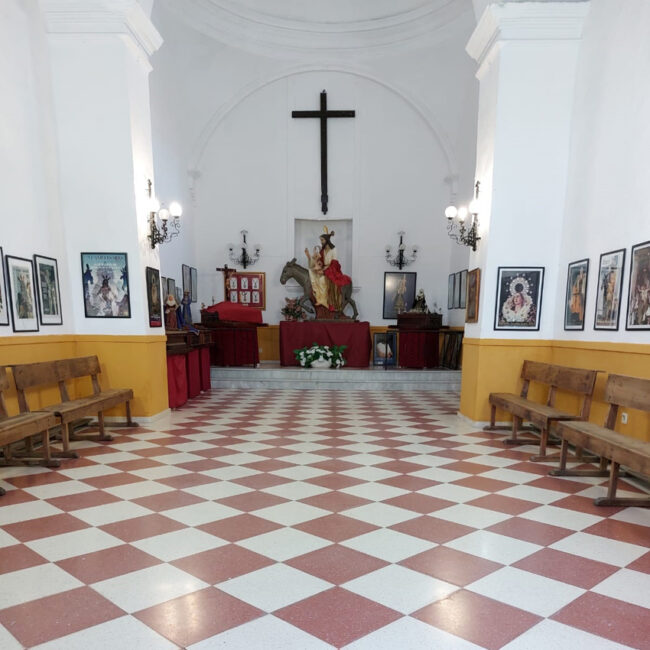
Située au nord-ouest du Paseo de las Calleras, elle se distingue par sa façade blanchie à la chaux surmontée d’une croix en fer. Son origine remonte à 1612, lorsque la confrérie du même nom en promut la construction. Après deux siècles d’utilisation, le bâtiment fut reconstruit au XVIIIe siècle en raison de son mauvais état, et en 1810 il fut béni comme église auxiliaire de la paroisse Saint-Barthélemy.
À la fin du XIXe siècle, il fut de nouveau restauré grâce au prêtre Trinidad Comas, qui le transforma en école catholique. Après la guerre civile, il fonctionna comme école maternelle nationale jusqu’à sa fermeture dans les années 1960. Malgré ses usages changeants, l’ermitage reste un repère architectural dans le paysage urbain d’Espejo.
Located in the northwest of Paseo de las Calleras, it stands out for its simple whitewashed façade crowned by an iron cross. Its origin dates back to 1612, when the brotherhood of the same name promoted its construction. After two centuries of use, the building was rebuilt in the 18th century due to its poor condition, and in 1810 it was blessed as an auxiliary church of the Parish of Saint Bartholomew.
At the end of the 19th century, it was restored again thanks to the priest Trinidad Comas, who converted it into a Catholic school. After the Civil War, it served as a National Nursery School until its closure in the 1960s. Despite its changing uses, the hermitage remains an architectural landmark within the urban landscape of Espejo.
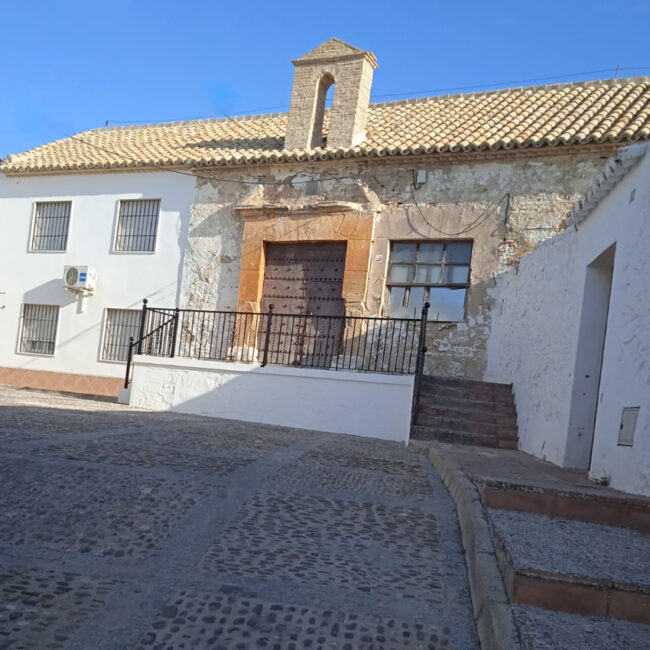
Construite au XVIIe siècle et agrandie en 1784, c’est un bâtiment à nef unique avec un dôme abaissé sur pendentifs au-dessus de la chapelle principale. L’agrandissement fut financé par Don Manuel de Gracia, qui encouragea la création d’une vaste chapelle latérale dédiée à la sainte.
Sa sobre façade en pierre à linteau droit et son clocher-mur supérieur, aujourd’hui sans cloche, se distinguent. Bien qu’elle soit actuellement fermée au culte, l’ermitage conserve sa valeur patrimoniale au sein de l’ensemble historique d’Espejo.
Built in the 17th century and expanded in 1784, it is a single-nave building with a lowered dome on pendentives over the main chapel. The expansion was financed by Don Manuel de Gracia, who promoted the creation of a spacious side chapel dedicated to the saint.
Its sober stone lintelled façade and upper bell gable, now without a bell, stand out. Although it is currently closed for worship, the hermitage preserves its heritage value within the historic complex of Espejo.
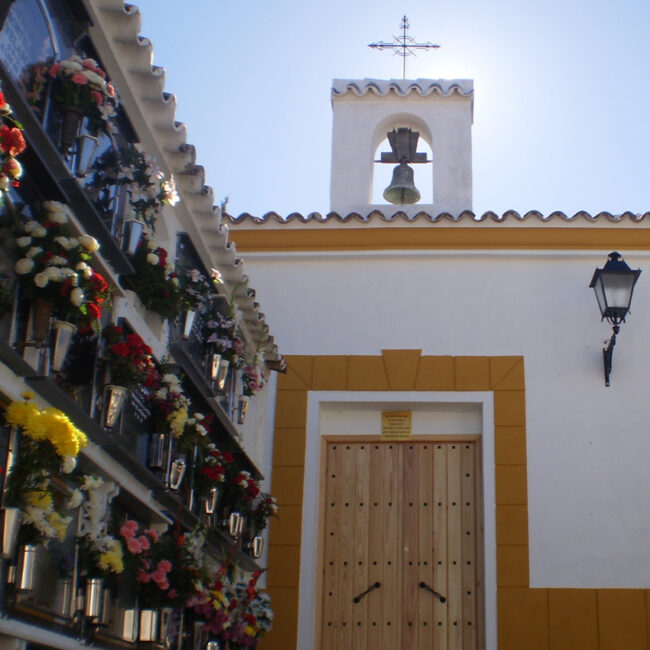
Está dedicada al patrón del municipio, San Roque. Aunque no se dispone de información detallada sobre su arquitectura o antigüedad, su existencia está documentada desde al menos mediados del siglo XVIII. En 1752, el Catastro de Ensenada ya menciona una ermita en honor a este santo en la localidad.
Desempeña un papel central en las festividades locales, especialmente durante la feria en honor a San Roque, que se celebra del 15 al 17 de agosto.
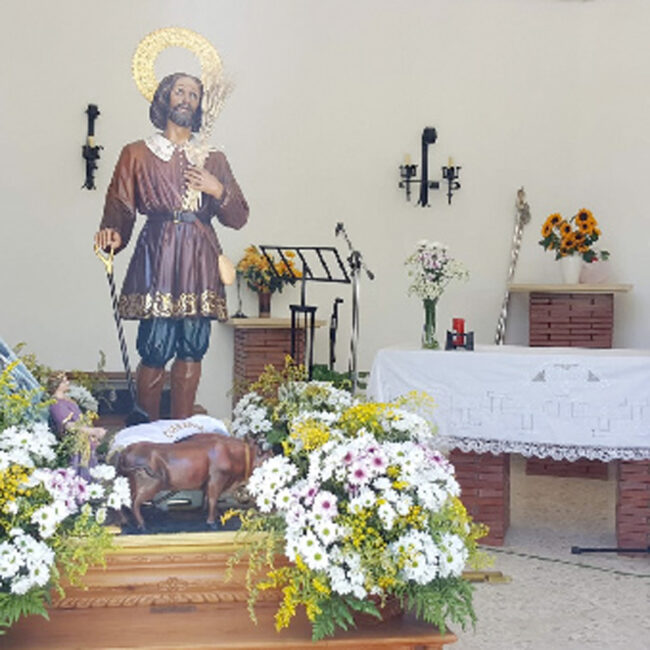
Se encuentra a aproximadamente un kilómetro del núcleo urbano, en un olivar de propiedad privada. Fue construida entre 1985 y 1986 por iniciativa del párroco Don Enrique Aparicio, en terrenos cedidos por un particular. El entorno de la ermita está rodeado por una arboleda que proporciona sombra al recinto, donde se celebra la romería de San Isidro.
En esta ermita se oficia la misa el 15 de mayo, día de la romería en honor a San Isidro Labrador, patrón de los agricultores. Durante las fechas cercanas, también se celebran novenas al santo en la ermita.


