


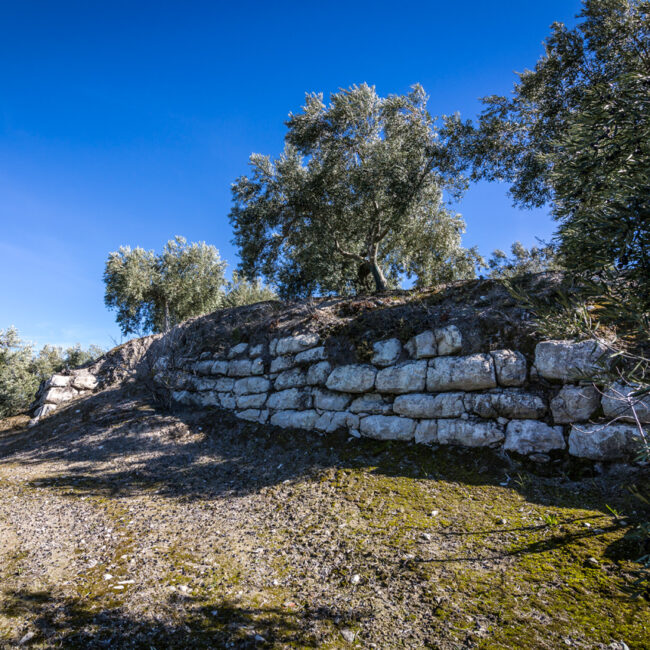
C’est l’un des plus grands « ensembles fortifiés » du territoire communal de Nueva Carteya, présentant une grande complexité architecturale. Il possède un caractère nettement défensif, avec un grand bâtiment central entouré d’une puissante muraille dotée de bastions. Son occupation remonte à l’époque ibérique (début du IVᵉ siècle av. J.-C.) et se prolonge jusqu’à l’époque alto-impériale (Iᵉʳ siècle apr. J.-C.).
It is one of the largest “fortified enclosures” in the municipality of Nueva Carteya, with great architectural complexity. It has a distinctly defensive character, featuring a large central building surrounded by a strong wall with bastions. Its occupation dates back to the Iberian period (early 4th century BC) and continued until the Early Imperial period (1st century AD).
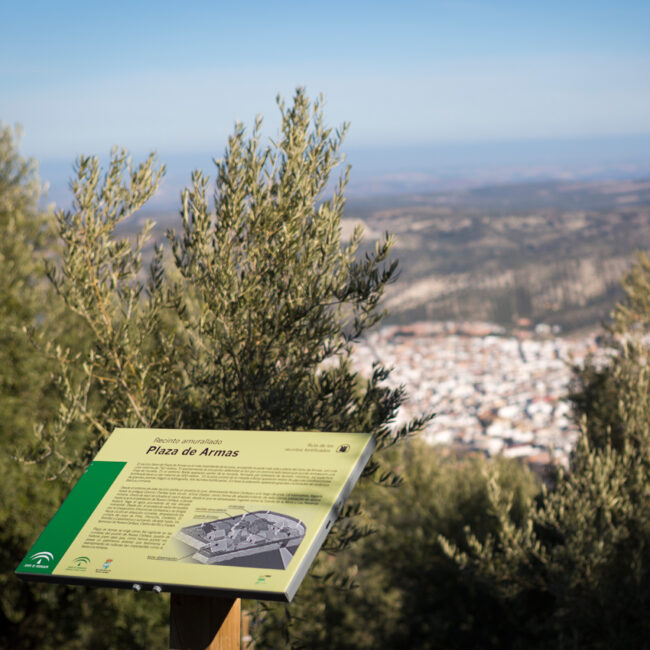
Parmi les vestiges historiques de Nueva Carteya se distingue l’ancienne Enceinte Murée de la Place d’Armes, où subsistent encore des éléments des défenses qui protégeaient autrefois le noyau originel de l’établissement. Cet espace, aujourd’hui intégré à la vie urbaine, rappelle l’importance stratégique qu’a eue la localité et fait partie du tracé historique conservé jusqu’à nos jours.
Among the historical remains of Nueva Carteya, the ancient Walled Enclosure of the Parade Ground stands out, where parts of the defenses that once protected the original core of the settlement are still preserved. This area, now integrated into urban life, continues to evoke the strategic importance the town once held and forms part of the historic layout that has endured to the present day.
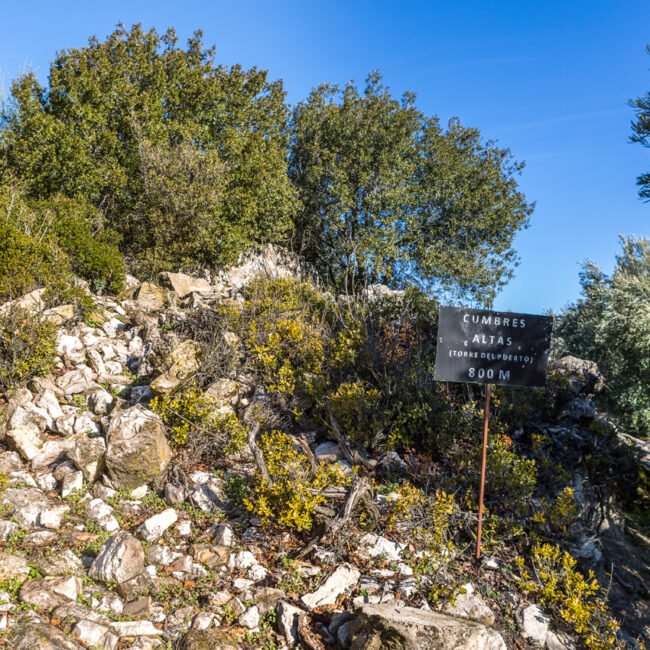
Au point le plus élevé de la commune, à 804 mètres d’altitude, dans la chaîne de collines du mont Horquera, se dresse une tour cylindrique construite en pierre calcaire entre les XIIIᵉ et XIVᵉ siècles apr. J.-C. Il s’agit d’une tour de guet — un terme dérivé de l’arabe signifiant « surveillance ». À l’époque où cette région constituait une frontière entre chrétiens et musulmans, la tour servait à surveiller les chemins et à donner l’alerte en cas de danger en allumant des feux sur son toit.
At the highest point of the municipality, at 804 meters above sea level, in the chain of hills of Monte Horquera, stands a cylindrical tower built of limestone between the 13th and 14th centuries AD. It is a watchtower —a term derived from Arabic meaning “vigilance.” When this region was a frontier between Christians and Muslims, the tower served to monitor the roads and give warning in case of danger by lighting bonfires on its rooftop.
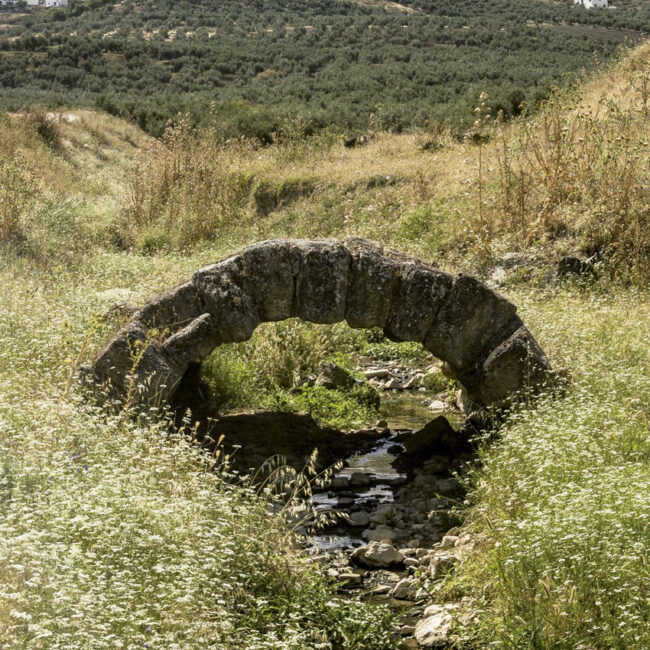
À quelques mètres au nord-ouest d’Espejo se trouve le pont romain de La Pontanilla, une construction à arche unique en plein cintre, érigée en blocs de grès taillés. Son origine est liée à une ancienne voie reliant Ategua à Spalis en passant par la colonie romaine d’Ucubi, traversant le ruisseau Malperdido.
Cette route, probablement d’origine ibérique, fut le témoin du passage des troupes pendant la campagne de César avant la bataille de Munda en 45 av. J.-C. Aujourd’hui, La Pontanilla constitue un vestige essentiel de l’héritage romain dans le réseau de communication du territoire.
Just a few meters northwest of Espejo lies the Roman bridge of La Pontanilla, a single semicircular arch structure built with sandstone ashlars. Its origin is linked to an ancient road that connected Ategua with Spalis through the Roman colony of Ucubi, crossing the Malperdido stream.
This route, probably of Iberian origin, witnessed the passage of troops during Caesar’s campaign before the Battle of Munda in 45 BC. Today, La Pontanilla stands as a key remnant of the Roman legacy in the region’s communication network.

À environ deux kilomètres d’Espejo, le long de l’ancien chemin de Castro, se trouve le site archéologique de La Fuensanta, où se mêlent tradition religieuse et héritage romain. On y voit les vestiges d’un ermitage du XVIe siècle dédié à la Vierge de la Fuensanta, érigé à côté d’une source qui reste un symbole de dévotion populaire. La légende attribue sa fondation au souhait exprimé par la Vierge elle-même à un berger.
Sous l’ermitage se conserve une remarquable citerne romaine, construite sous le règne d’Auguste, qui démontre la maîtrise hydraulique des ingénieurs de l’ancienne Ucubi. Ce réservoir, doté de voûtes en pierre de taille et d’une canalisation de plus de 27 mètres, fonctionne encore aujourd’hui, alimentant la zone en eau et rappelant la continuité d’un culte ancestral de l’eau comme source de vie.
About two kilometers from Espejo, along the Old Road to Castro, lies the archaeological site of La Fuensanta, where religious tradition and Roman heritage come together. There stand the remains of a 16th-century hermitage dedicated to the Virgin of Fuensanta, built next to a spring that continues to be a symbol of popular devotion. Legend attributes its foundation to the Virgin herself, who is said to have expressed her wish to a shepherd.
Beneath the hermitage is a remarkable Roman cistern, built during the reign of Augustus, which demonstrates the hydraulic expertise of the engineers of ancient Ucubi. This reservoir, with ashlar-vaulted ceilings and a channel over 27 meters long, still functions today, supplying water to the area and recalling the continuity of an ancestral cult of water as a source of life.


