


A journey through the living memory of the towns of Al-Andalus in the Guadajoz region of Córdoba
They descended from the hills into the fertile plain of the Guadajoz, where the river, serene and ancient, wound its way among groves, orchards, and sown fields. The path narrowed as they approached the banks, and the murmur of the water grew clearer.
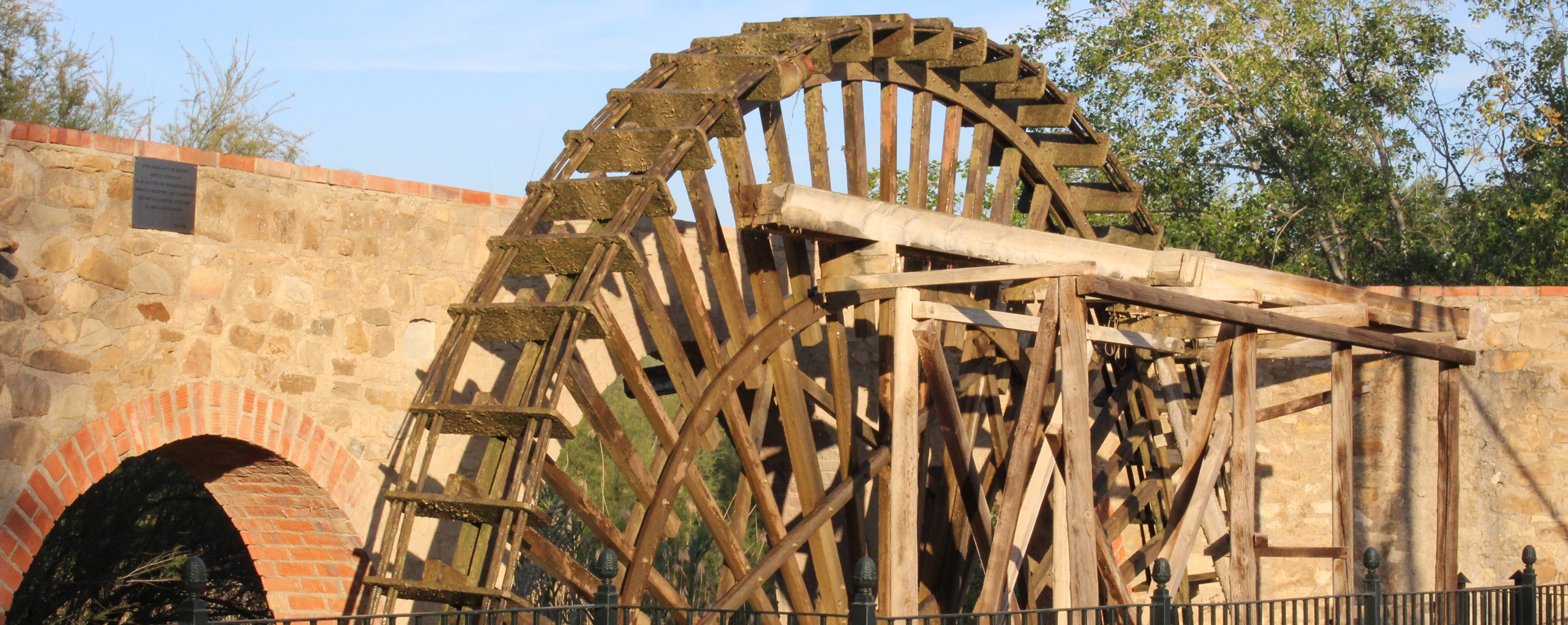
It was then that they saw it, as they rounded a bend in the path: a great wooden wheel turning slowly, biting into the water with its paddles and lifting, in its ascent, small vessels that poured their contents into a channel held aloft by stone pillars.
Carmen stopped abruptly and looked at it as if recognizing an old friend.
—That’s it!—she exclaimed—. It’s the Albendín waterwheel. In my time there’s an identical replica. My parents used to bring me to see it when I was little. I was fascinated watching it turn; there’s something hypnotic about it.
Qāsim stepped up to one of the stone abutments that supported the axle of the waterwheel. He rested his hand on the structure and followed with his eyes the course of the water along the channel, attentive and silent. Then he turned his face slightly toward her.
—It is ancient wisdom: technique placed at the service of necessity. We call this wheel that turns without rest naʿūra. And it was not born here: its origins go back to eastern lands, to Syria, to the valleys of Mesopotamia, to the engineers of the Tigris and the Euphrates. But here, in al-Andalus, we perfected it, adapting it to our rivers and our needs. And thanks to it, this land flourished.
He walked a few steps and pointed to the azuda, the low weir that redirected the river’s flow into a narrow channel.
—Look: everything begins with the azuda, which serves to guide the water. Its structure of stakes, stones, and earth diverts part of the current into the canal. The water then flows here, where the gate—the aguatocho—is opened or closed, and as it strikes the paddles, it sets the wheel in motion. No animals or slaves are needed to turn it. Only the strength of the river.”
Carmen stepped closer, watching as the cangilones—small ceramic containers fastened to the rim of the wheel—scooped up the water at its lowest point and, as the wheel turned, lifted it until they poured it into a stone channel supported by an elevated structure.
—And that channel?
—It is called the añaquil. It’s like a small aqueduct. The water poured there is carried by gravity through ditches that cross the orchards. In this way, the entire plain is irrigated. Each plot receives its turn. There is a calendar and a water master who oversees it. Everything is ordered.
—And is this common?
—Very much so. From the Guadalquivir to the Segura, from the plains of Granada to smaller rivers like this one. The waterwheels allow lands that were once barren to be irrigated, freeing many hands, since the noria works day and night without rest.
Carmen turned, looking at the fields stretching beyond the waterwheel. Farmers worked the furrows, children ran along the dirt paths, and women filled pitchers at the channels. Everything revolved around the great wooden wheel.
—As you can see, it is the heart of the alquería —said Qāsim—. Where the river does not reach, the ingenious wheel does. Thanks to these waterwheels, agriculture ceases to be merely a means of subsistence and becomes a source of wealth. They make trade possible, ensure the supply of cities, and even allow for export. Behind this structure there is science. There is hydraulics. There is engineering. There is precision i
—And that sound…—said Carmen, pointing to the monotonous creak of the buckets as they poured out the water.
Qāsim smiled.
—It is the moan of the naʿūra. In Arabic, the name comes from nawa‘ra, ‘the one that moans.’ That groan is its mark, its voice. It is part of the landscape.
—And to think that, centuries later, they would build a replica. So it would not be forgotten—Carmen added, with a trace of tenderness.
Qāsim nodded silently, his gaze still fixed on the constant turning of the buckets. For a few moments, they said nothing and simply enjoyed that melody.
After a while, they resumed their walk.


