


Immerse yourself in the Andalusian culinary heritage through the restaurants of Guadajoz that have taken part in our gastronomic workshops, reviving recipes, aromas, and flavors that connect us with our history.
Castro del Río
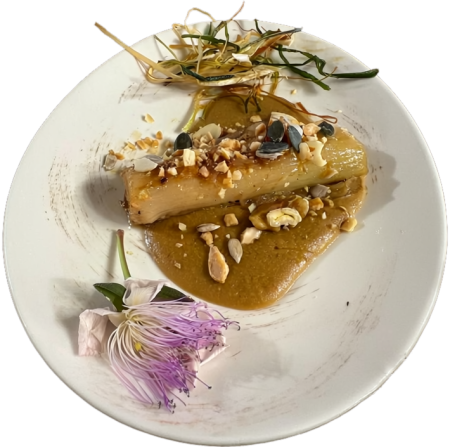
Andalusí-style leeks
The leek (kurrath in Arabic) was one of the most valued vegetables in Al-Ándalus, both in popular cuisine and in the medicine of the time. It was slowly cooked, confit in oil with mild spices and nuts.
Grilled artichokes with foie
This recipe was presented as a contemporary reinterpretation of Andalusí roots: the grilled artichoke was flavored with EVOO, wine salt, and pepper, and topped with a medallion of foie briefly seared over the fire. Although duck foie as we know it today did not appear in Al-Ándalus, there are indeed mentions of fatty offal cooked in contrast with bitter vegetables, as a symbol of balance. The contrast between vegetal bitterness and richness refers to the sensory refinement typical of Umayyad court cuisine.
Spiced kidneys Andalusí style
The kidneys were meticulously cleaned and marinated with lemon juice. They were seared in very hot EVOO and flavored with cumin, black pepper, paprika, a touch of cinnamon, and wine vinegar. A recipe that pays homage to the typical inland stews of the Caliphal period, where offal was cooked as delicacies with spices brought from the East.
Cod in two versions
Traditional version: desalted cod, cooked with sliced garlic fried in EVOO and served with a raisin and almond vinaigrette.
Contemporary version: cod loin confit in EVOO, toasted almonds, petals, and a handmade unleavened bread crisp. The technique of slow cooking and oil emulsion was explained as a legacy of Al-Ándalus cuisine.
Almond and fig cake
Made with ground almonds, rehydrated dried figs, free-range eggs, and honey. A true jewel of Moorish pastry.
Llano del Espinar
Fresh broad bean gazpacho
A recipe of peasant origin: peeled broad beans, stale bread crumbs, garlic, white wine vinegar, salt, EVOO, and fresh mint, all ground by hand until obtaining a thick, green soup. Its ancestral use as a refreshing spring dish was explained.
Andalusí-style chicken in pepitoria
Chicken pieces stewed in a base of onion, bay leaf, and wine, thickened with a mash of fried bread, almonds, cooked egg yolk, and saffron. The chef explained how this dish, of Arab origin and Sephardic transmission, represents the blending of cultures that characterized Al-Ándalus.
Valenzuela
Hen with almonds Andalusí countryside style
Free-range hen, browned in a clay pot with EVOO, whole garlic cloves, and bay leaf. Midway through cooking, a mash of toasted almonds, fried bread, chicken broth, and cumin was added. It was explained how this technique — slow stewing with a base of nuts — was a constant in the kitchens of Al-Ándalus, for its capacity for preservation and flavor.
Nueva Carteya
Floral salad with Moorish base
Made with green apple, macerated quince, smoked sardine, local goat cheese, walnuts, rose and marigold petals, and dressed with EVOO, wine vinegar, and orange blossom water. The aesthetic and symbolic importance of salads in Nasrid palace cuisine was explained, where color, fragrance, and harmony were as relevant as flavor.
Artichokes with red partridge and saffron
Hand-peeled artichokes stewed with red onion, garlic, white wine, bay leaf, and spices (saffron, pepper, clove). The partridge, previously marinated with herbs and oil, was added to the stew and slowly cooked until achieving a tender, melting texture. A dish that reflects the combination of nobility and rusticity characteristic of Andalusí countryside recipe collections.
Rice pudding with spiced honey
Goat’s milk, fine-grain rice, lemon peel, clove, cardamom, cinnamon stick, and a final touch of rosemary honey. The Andalusí roots of this dessert were explained, present in 13th-century recipe collections such as the Fadalat al-jiwan.
Baena
Cordoban mazamorra with raisins and chopped egg
Stale bread, raw almond, garlic, white wine vinegar, EVOO, and salt, all emulsified until achieving a smooth, white cream. The chef explained how mazamorra was the precursor of salmorejo, and how its texture was ideal for rural areas due to its easy preparation and preservation.
Stewed kid with rice and spiced couscous
Kid marinated with garlic, bay leaf, nutmeg, clove, pepper, and cooked at low temperature for several hours. It was served with rice and couscous. The dish was presented as a fusion between Moorish and Berber traditions, with strong symbolic significance.
Espejo
Almond ajoblanco
Peeled raw almond, stale bread crumbs, germ-free garlic, white wine vinegar, EVOO, and salt. Everything was ground and emulsified until achieving a cold, smooth, slightly thick white cream. The chef explained how this cold soup, mentioned in Moorish recipe collections as white gazpacho, was valued both for its refreshing effect and its digestive character. Traditional in the orchards of the Guadajoz, where almond and garlic were self-sufficient products, ajoblanco has endured for centuries as an example of rural elegance.
Beef meatballs in spiced vegetable sauce
The beef was mixed with fresh parsley, ground cumin, breadcrumbs, and egg. Medium-sized balls were formed and seared in a clay pot with EVOO. Separately, a base sauce was prepared with onion, eggplant, and carrot, all slowly sautéed until caramelized. Among other spices, pepper, clove, and a pinch of cinnamon were added, along with grated tomato and a broth base. The meatballs were incorporated and stewed slowly for 30 minutes.
The chef explained how this recipe evoked the Andalusí al-bunduq — spiced meatballs — documented in texts such as the Fadalat al-Jiwan. In the Guadajoz, slow stews with vegetables are still common in home cooking and popular celebrations. The result was a tender, fragrant, and robust dish, served over couscous flavored with raisins and mint.
Curd with honey
Whole goat’s milk, warmed and mixed with natural rennet. Once set, it was served cold in individual bowls, with warm rosemary honey poured over and a touch of ground cinnamon. It was decorated with almond flakes and dried rose petals.
The chef recalled how this recipe, present in Andalusí recipe collections such as leben ma’asal, was considered a food of purification, offered at the end of banquets. In the region, curd has been preserved as a Lent and shepherds’ dessert, thanks to the local livestock tradition. The combination of milk and honey sums up the simplicity and refinement that define Andalusí cuisine.
Albendín
Traditional saffron migas
Dark rustic bread, hand-torn, soaked in lightly salted water, and left to rest under a cloth. In a deep pan, whole garlic cloves were browned in EVOO, and the drained bread was slowly added, stirred constantly with a wooden spatula. Midway through cooking, water infused with saffron and a mash of sweet paprika, salt, and a touch of cumin were incorporated. The migas were finished with grapes, radishes, and melon, fruits and vegetables highly valued in Al-Ándalus.
The chef explained that the use of saffron in migas, uncommon today, was frequent in festive or ritual versions of this dish in Andalusí times, where its golden color and warm aroma were valued as a symbol of prosperity. In Al-Ándalus, migas were known as thurid or firid, and were prepared in rural celebrations with humble ingredients treated with care. In the Guadajoz, this dish is still present in grape harvests, slaughters, and family gatherings, as a meal made by many hands and served to be shared.
Mesón
Guadajoz
Castro del Río
C. los Molinos, 26, 14840
Castro del Río, Córdoba
+34 696 895 124
Bar
Bujerillo
Llano del Espinar
Av. Castro del Río, 66C, 14858
Llanos del Espinar, Córdoba
+34 957 67 98 01
Violín Taberna
desde 1972
Nueva Carteya
C. Francisco Merino, 11, 14857
Nueva Carteya, Córdoba
+34 648 209 402
Bodega Palacios Restaurante
Baena
Av. Padre Villoslada, 65, 14850
Baena, Córdoba
+34 653 930 757
If you’re making a reservation, please mention that you’re following the Guadajoz Andalusí project route, so the restaurants can offer you unique dishes from the route


