


A journey through the living memory of the towns of Al-Andalus in the Guadajoz region of Córdoba
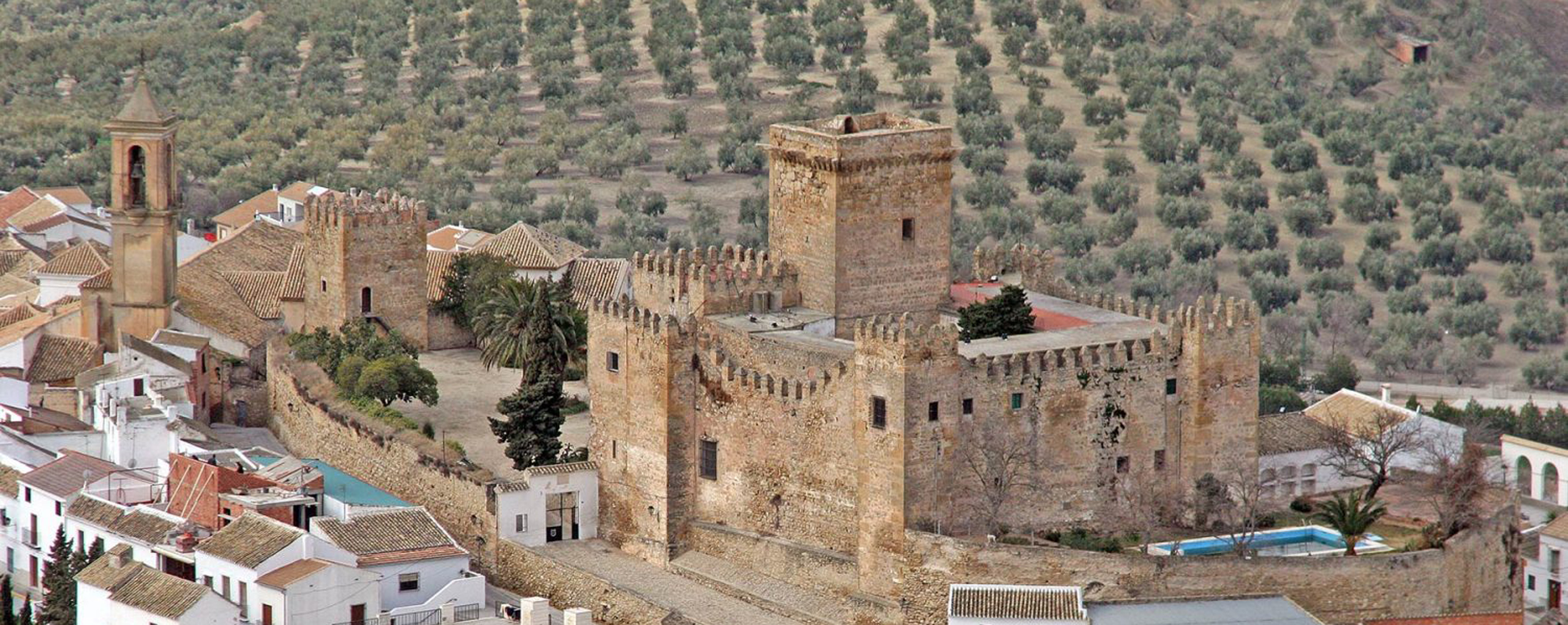
Carmen opened her eyes and found herself atop a sober, austere construction that overlooked the countryside. What she saw before her was al-Qalʿa, the old Andalusi fortress that today is the Castle of Espejo: a defensive tower, but without a city yet surrounding it.
A few steps away, a man in a light tunic, carrying a wooden staff, his face weathered by time, was silently gazing at the horizon. He did not seem surprised to see her, and Carmen was not startled by his presence either. It was as if she had been expecting him.
—You have arrived —he said without turning—. And you have arrived in time.
—In time for what?— Carmen asked, still not fully understanding where she was.
—To uncover the Andalusi secrets of the Guadajoz region of Córdoba,— the old man replied in a calm voice—. The wisdom of its people, the work of anonymous hands… and the stones we raised so that time would not forget us.
He turned toward her with a serene expression.
—I am Qāsim b. Aṣbag, from Bayyāna. Jurist, historian, teacher of caliphs… and bearer of memory. But what I know I did not learn only from books, but also from the men and women who gave life to these lands. Come. This region still holds stories that deserve to be heard.
Carmen approached, both confused and fascinated in equal measure.
From above, the landscape unfolded with gentle hills, endless olive groves, and dusty paths that crossed like veins. In the distance, the bluish outlines of the sierras, and beyond them, the invisible line where the Nasrid kingdom began.
—We are in Espejo —Carmen said softly, almost surprised to hear herself—. I recognize it… but it looks different.
Qāsim nodded slowly, his eyes fixed on the horizon.
—It is, but not the Espejo you know. This is Espejo in Andalusi times: smaller and humbler, but alive.
—And what exactly was this place in your time? —she asked, her voice almost reverent.
—Al-Qalʿa, which means ‘the fortress.’ This was all: a tower, a courtyard, and an underground cistern. In Andalusi times, this hilltop was a watch bastion. From here three routes were controlled: to the north, Qurṭuba (Córdoba); to the east, Qāšruh (Castro del Río); to the south, Bayyāna (Baena) and, beyond, the old road to Gharnāṭah (Granada).
—The Caliphate Route? — Carmen said.
Qāsim smiled.
—That is what you call it now. A beautiful name. Along here passed the emir’s envoys, tax collectors, caravaners with their mules loaded with silks, salt, and spices. Soldiers too, of course. Sometimes ours, sometimes not.
—It is still used today— Carmen interrupted—. Though no one travels it like then. Today it’s a cultural route. It goes from Córdoba to Granada and passes through here, through Espejo. Some people even ride it by bicycle, machines with wheels that you pedal to move forward.
Qāsim regarded her closely.
—I like that. That people still use the old routes, even if it is on those machines with wheels.
He paused for a moment, as if arranging his memories before sharing them. Then he continued:
—This hill was chosen long before us. It was Ucubi in Iberian times, but it allied with Julius Caesar during the Roman civil wars and Pompey destroyed it. Later it was rebuilt and called Attubi. The Romans established their outpost here, their specula, but it was under the Umayyads that it took its current form: a fortified farmhouse, a sentinel of these lands.
Qāsim stopped in the center of the courtyard, where the arches cast curved shadows over the stone floor.
—The cistern is right below —he said, pointing to an opening in the pavement, protected by a stone curb.
They descended a staircase that led to the underground cistern. The air changed instantly: cooler, denser. The whitewashed walls gleamed with the moisture accumulated over centuries.
—Here we collect the rain —Qāsim explained as his footsteps echoed softly in the vault—. In a land like this, water is synonymous with life, endurance, and sovereignty. As long as there is water down here, the fortress can withstand sieges for much longer.
Carmen brushed the wall with her fingertips, letting the coolness run through her skin.
—This isn’t the only cistern I’ve seen in Espejo —she said—. On the outskirts, near the old Roman road, there’s another one, from Roman times. It’s well preserved, restored, and open to visitors.
A brief silence followed. The echo of their voices seemed to fade among the stones, as if they still held the whispers of other eras.
—In my time —Carmen added, lowering her voice slightly—, some claim that this well is connected to secret tunnels. They say one of them leads to the Albuhera. No one has found them, but some still believe it.
They ascended back into the courtyard, leaving behind the dimness of the cistern. Inside the castle, Carmen let her gaze wander through the space, recognizing elements that in her own time were still preserved.
—Now they call it the Castle of Espejo, or the Ducal Castle. It was expanded centuries later by a Christian knight, Pay Arias de Castro. Towers, coats of arms, and walls were added… Today it belongs to a noble family. It is well preserved, with antique furniture, historic weapons, and restored rooms. It’s a place that imposes its presence.
She paused for a moment, thoughtful.
—All of that is part of its history and has great value, but what you’re showing me now… reveals another layer. It’s incredible how much a structure like this can hide, so many lives overlapping in a single stone.
Qāsim nodded, a faint smile on his face.
—That’s the fascinating thing about these places: they don’t have just one origin, but many. Each era left its trace. And every layer speaks, if you know how to listen.
He turned toward the exit and raised his staff, inviting her to follow.
—Come. This has only been the beginning. Now I will take you to a place where stone turns into salt, and where the land still holds the taste of other centuries.
The path began to descend gently among the olive groves. The ground changed, becoming whiter, cracked, speckled with salt crusts that glittered under the morning sun.
After a short while, the terrain opened into a wide expanse. In front of them, a succession of pools and channels formed a shining mosaic. Some lay dry, while others were covered by a thin layer of water that reflected the sky like a mirror.
—These are the saltworks —said Qāsim—. They are very precious to us, for they represent stability. As long as salt flows, there will be something to preserve, something to trade… and something to protect.
Carmen approached one of the ponds. The surface was patterned with cracks from evaporation, and along the edges, old conduits appeared—just like those still preserved in her own time.
—These are the Duernas Saltworks —she said—. They are still active and produce nearly three thousand tons of salt a year. The water here is four times saltier than seawater. In the past, it was extracted with waterwheels pulled by animals, later with more advanced mechanisms. Today they use pumps, but many things remain almost the same.
—Then the cycle has not been broken—. said Qāsim with a serene smile—. This land has sweated salt since ancient times, and we too made use of it in Andalusi times. It was not only used to preserve food; it was also essential for the digestion of livestock.
He stopped by one of the dry pools and bent down to pick up a handful of crystals.
—We also used it as medicine: to clean wounds, to induce vomiting, or even to restore appetite. Ibn al-Bayṭār, a scholar of my time, says it can awaken the heart. Though he also warns that excessive use harms the eyes and the blood. Like all power, it requires balance.
—And is it easy to obtain?— Carmen asked.
—It is not scarce, but it is regulated. The State—the walī, the governor—usually controls its extraction. In some places, a tax is paid for each load. And in the souks, there is always a stall for salt.
They stopped at the edge of a large pool that still held water. The reflection was so clear it seemed like a doorway to another sky.
—Memory came here too —said Qāsim—. Some believed salt helped prevent forgetting. That is why, in certain tombs, a few grains were left—so the soul could remember the way.
—And yet —Carmen added—, almost no one knows that this already existed in Andalusi times. That salt was more than just a resource: it was part of a living culture.
—That is why we are here —Qāsim replied—. To see what remains, even if time has dressed it in another form.
A gentle breeze, laden with the dry, mineral scent of the saltworks, caressed their faces. Carmen and Qāsim exchanged a glance, and without another word, they continued walking.


